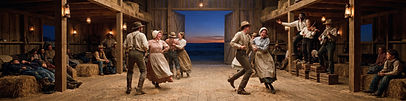
The History of Western Dance
From Elizabethan Parlors to Today's Dance Floors

A Saturday night, somewhere. A wooden floor, boots, a tune kicks in, and the floor fills up. No one, that night, is thinking of Elizabeth I's England, a village in Bohemia, a Harlem ballroom, or a Texas ranch. And yet every one of those places is there, in the step just taken.
Because none of these dances was born where it is danced. They arrived by ship, by wave of migration, by a fluke of radio or film. They changed names, countries, peoples. A dance believed to be Scottish comes from Bohemia; a so-called Polish dance was invented in Paris by a Spaniard; the most emblematic dance of the white honky-tonks owes its defining gesture to enslaved Black musicians.
Nothing in this repertoire is pure. These are not fixed traditions handed down intact from the Old World: they are hybrids, shaped by the people who danced them, constrained by what they had on their feet. The cowboy boot reshaped the waltz step. The floor of a dance hall built by Czech immigrants reshaped the two-step. At every border crossed (geographic, social, racial) the dance gained something and lost all trace of someone.
The articles that follow trace that thread, dance after dance, from the Elizabethan parlors to today's dance floors. And each time, the same question, the simplest and the most dizzying: where does what we dance tonight really come from?